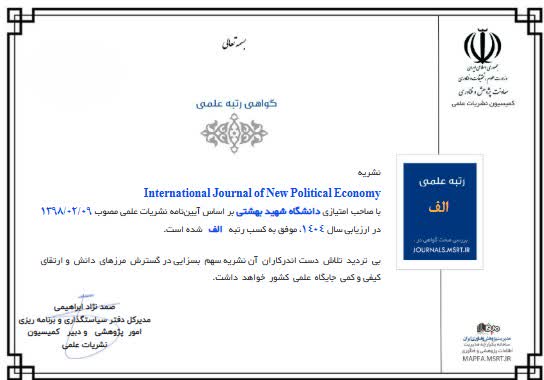
International Journal of New Political Economy

International Journal of New Political Economy

International Journal of New Political Economy is an open access double-blind peer-reviewed semiannually journal, owned, managed, and published by Shahid Beheshti University since 2020. The journal publishes original full-length articles, reviews, and letters relevant to political economy including law, sociology and the like to publish their theoretical and practical research in the field of economics, politics and political economy. 

Contributions may address, but are not limited to:

  • Political economy and economic governance
  • New approaches to political economy
  • Economic and public policy
  • Political institutions and economic development
  • Law, institutions, and political economy
  • Governance, regulation, and public administration
  • International political economy
  • Development economics and political economy
  • Political economy of globalization and international relations
  • Sociology and political economy
  • Economic inequality, poverty, and social justice
  • Taxation, fiscal policy, and public finance
  • Institutions, democracy, and economic performance
  • Digital transformation and the political economy of technology
  • Environmental and climate political economy
  • Geopolitics, sanctions, trade, and economic relations
  • Contemporary challenges facing developing and emerging economies
  • Interdisciplinary approaches linking economics, politics, law, and sociology

About the Journal:
 
Country of Publication 
Iran: Tehran
Journal Title International Journal of New Political Economy
E-ISSN 3060-6233
Frequency Semiannually
Editor-in-Chief Yadollah Dadgar, Ph.D.
Language English Fulltexts & Abstracts
Plagiarism Checker iThenticate
Peer Review Policy Double-blind
Article Processing Charges See Here
Average Review Time 4 Months
Acceptance Rate 35%
Owner & Publisher Shahid Beheshti University, Iran.
Cooperation with the Association This journal  cooperates with the Iranian Economists Association 

Publication Ethics

This journal is following of Committee on Publication Ethics (COPE) and complies with the highest ethical standards in accordance with ethical laws (COPE) 

Citation Style

The APA referencing style

Copyright

Authors retain unrestricted copyrights and publishing rights.

Type of License

Creative Commons — Attribution-NonCommercial 4.0 International (CC BY-NC 4.0)

Required files to be uploaded

 Essential files must be submitted through the manuscript submission system: 1. The main file of the manuscript (without the names). 2. Title page, 3. Authors form (Guidelines),  4. Commitment to Publishing Ethics, 5.Conflict of Interest Disclosure 

Orchid ID

An Orchid ID is required for all authors. You can register here (https://orcid.org/register)

Authors' Guide

Dear authors, please refer to the Authors' Guide for Authors section for information on how to complete the forms and response times.

iThenticat

This Journal uses the iThenticate system as similarity checker tool for articles.

 Address

 International Journal of New Political Economy, Faculty of Economics and Politics, Shahid Beheshti University, Evin, Tehran, Iran.

Phone:+98 (021) 29902969.Saturday to Wednesday from (text message and social media)

E-mail: jep@sbu.ac.ir

Postal code: 1983963113


Current Issue: Volume 7, Issue 2, 2026, Pages 1-374 

Keywords Cloud

  • Iran
  • Political Economy
  • Economic Growth
  • Economic Development
  • Inflation
  • Tehran Stock Exchange
  • Covid-19
  • Human rights
  • Democracy
  • Institutional Quality
  • economic sanctions
  • Stock market
  • panel data
  • Monetary Policy
  • Foreign direct investment
  • Financial Development
  • Foreign Trade
  • Productivity
  • Digital Economy
  • bitcoin
  • Fuzzy logic
  • optimal tax rate
  • Financial Performance
  • Power matrix
  • Islamic Banking
  • Nigeria
  • Human development
  • Economics
  • Tax Revenue
  • Rent
  • Rentier State
  • Financial Inclusion
  • asymmetric effects
  • Governance
  • University
  • Clustering
  • Geopolitics
  • COVID-19 Pandemic
  • Banks
  • Policy-making
  • Quantile Regression
  • Turkey
  • Economic Vulnerability
  • Public choice
  • Shadow Economy
  • Interdisciplinary economics
  • D-8 countries
  • personal relevance
  • Developing countries
  • Discourse Analysis
  • CFR
  • Innovation Ecosystem
  • Iranian banking system
  • Dutch Disease
  • R*FMP model
  • International organizations
  • Short-Term Society
  • Polycentric Democracy
  • Intangible Investment
  • Kazakhstan
  • Rent Seeking
  • Security Council
  • Intertemporal Approach
  • Partner narcissism
  • Gross Domestic Production
  • Knowledge-Based Enterprises
  • Bilateral trade
  • Ruling Coalition
  • Socioeconomic pressure
  • Behavioral Economics
  • Johansen cointegration
  • endogenous equilibrium
  • Investment Efficiency
  • Economic Complexity
  • making decisions
  • World Value Survey
  • Venture Capital
  • freedom
  • Audit report readability
  • Regional relations
  • technology gap ratio
  • Economic Reform
  • Ease of Doing Business
  • Keywords: Oil price volatility
  • Basic Limited Access Order (BLAO)
  • banking industry
  • cooperation
  • Human Rights Language
  • Regional Imbalances
  • nuclear-related sanctions
  • Private Sector Consumption
  • Cost-push inflation
  • Markov-Switching Vector Error Correction Model (MS-VECM)
  • Syria
  • Energy Security
  • Oil Crisis
  • Tax system evolution
  • McCabe\' s Complexity
  • Public debt
  • Spatial spillover effects
  • Political Theory
  • Trade Agreement
  • Dynamic programming
  • Iraqi banking system
  • Mehdi Haeri
  • Economic disaster
  • crime
  • Capital market efficiency
  • United State
  • Structural Vector Autoregression (SVAR)
  • East Asia
  • Power Struggle
  • NARDL
  • Springback Pressure
  • Auditing Firms
  • World Bank
  • Economic History
  • Liberal Interventionism
  • Competitive Advantage
  • e-commerce
  • Housing Assets
  • Updated Traditional Clothing
  • Human Development Index
  • Microfinance evolution and development
  • Direct Tax
  • Macroeconomic Uncertainty
  • Malaysia
  • Pollution
  • United Arab Emirates
  • Audit expertise
  • Return on Investment (ROI)
  • Financial organizations
  • Grounded theory
  • Undocumented workers
  • Digital Economy Index
  • gravity model
  • ARCH
  • United States
  • Trade discrepancies
  • Social Security Organization
  • Power Generation Companies
  • concurrent
  • Campaign Finance
  • banking fragility
  • operational risk
  • Exchange rate volatility
  • MIMIC
  • Domestic dollarization
  • China
  • Dynamic Spillover
  • Religious Politics
  • Ibn-khaldūn
  • Key Words: Electronic Payment Systems
  • Financial Complexity
  • Futures Contract
  • Succession
  • Islamic civilization
  • FDI inflow
  • Brexit
  • Energy Subsidies
  • Fog index
  • Dispersed Responsibility Agency
  • E3 Models
  • civil society
  • Uncertainty
  • corporate value
  • Government Budget
  • Shuracracy
  • Electricity Generation
  • household equivalence scale
  • Control Engineering
  • Quasi-authoritarian
  • Anzali Free Zone
  • Economic Crimes
  • K-Means
  • tourism development
  • ICIO
  • Volatility
  • Exchange Rate Overshootings
  • Trust
  • Earning Investor Trust
  • Public Finance
  • UK Economy
  • Time series clustering
  • Absolute Spirit
  • Non-Performing Loans
  • Historical context
  • Törnqvist-Theil index
  • Life Cycle Saving
  • Economic Resilience
  • Economic Performance
  • Quasi-Experimental Design
  • marketing
  • Family stability
  • Pressure Groups
  • Resilience factors
  • Shopping time
  • Keywords: financial constraint
  • oil rent
  • K-Means Algorithm