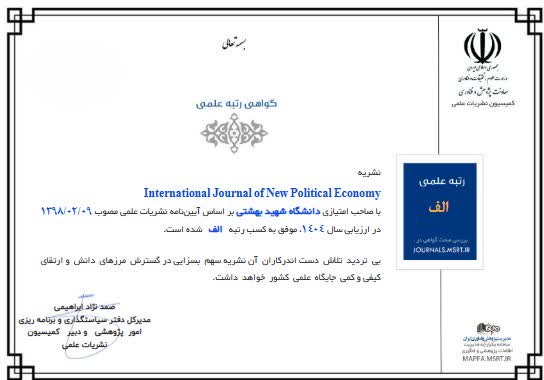
International Journal of New Political Economy

International Journal of New Political Economy

International Journal of New Political Economy is an open access double-blind peer-reviewed semiannually journal, owned, managed, and published by Shahid Beheshti University since 2020. The journal publishes original full-length articles, reviews, and letters relevant to political economy including law, sociology and the like to publish their theoretical and practical research in the field of economics, politics and political economy

Contributions may address, but are not limited to:

  • Political economy and economic governance
  • New approaches to political economy
  • Economic and public policy
  • Political institutions and economic development
  • Law, institutions, and political economy
  • Governance, regulation, and public administration
  • International political economy
  • Development economics and political economy
  • Political economy of globalization and international relations
  • Sociology and political economy
  • Economic inequality, poverty, and social justice
  • Taxation, fiscal policy, and public finance
  • Institutions, democracy, and economic performance
  • Digital transformation and the political economy of technology
  • Environmental and climate political economy
  • Geopolitics, sanctions, trade, and economic relations
  • Contemporary challenges facing developing and emerging economies
  • Interdisciplinary approaches linking economics, politics, law, and sociology

About the Journal:
 
Country of Publication 
Iran: Tehran
Journal Title International Journal of New Political Economy
E-ISSN 3060-6233
Frequency Semiannually
Editor-in-Chief Yadollah Dadgar, Ph.D.
Language English Fulltexts & Abstracts
Plagiarism Checker iThenticate
Peer Review Policy Double-blind
Article Processing Charges See Here
Average Review Time 4 Months
Acceptance Rate 35%
Owner & Publisher Shahid Beheshti University, Iran.
Cooperation with the Association This journal  cooperates with the Iranian Economists Association 

Publication Ethics

This journal is following of Committee on Publication Ethics (COPE) and complies with the highest ethical standards in accordance with ethical laws (COPE) 

Citation Style

The APA referencing style

Copyright

Authors retain unrestricted copyrights and publishing rights.

Type of License

Creative Commons — Attribution-NonCommercial 4.0 International (CC BY-NC 4.0)

Required files to be uploaded

 Essential files must be submitted through the manuscript submission system: 1. The main file of the manuscript (without the names). 2. Title page, 3. Authors form (Guidelines),  4. Commitment to Publishing Ethics, 5.Conflict of Interest Disclosure 

Orchid ID

An Orchid ID is required for all authors. You can register here (https://orcid.org/register)

Authors' Guide

Dear authors, please refer to the Authors' Guide for Authors section for information on how to complete the forms and response times.

iThenticat

This Journal uses the iThenticate system as similarity checker tool for articles.

 Address

 International Journal of New Political Economy, Faculty of Economics and Politics, Shahid Beheshti University, Evin, Tehran, Iran.

Phone:+98 (021) 29902969.Saturday to Wednesday from (text message and social media)

E-mail: jep@sbu.ac.ir

Postal code: 1983963113


Current Issue: Volume 7, Issue 2, 2026, Pages 1-374 

Keywords Cloud

  • Iran
  • Political Economy
  • Economic Growth
  • Tehran Stock Exchange
  • Inflation
  • Covid-19
  • Productivity
  • economic sanctions
  • Economic Development
  • Monetary Policy
  • Financial Development
  • Human rights
  • panel data
  • Stock market
  • Democracy
  • Foreign Trade
  • COVID-19 Pandemic
  • Fuzzy logic
  • Clustering
  • optimal tax rate
  • Shadow Economy
  • Foreign direct investment
  • Turkey
  • Geopolitics
  • Tax Revenue
  • Governance
  • Financial Inclusion
  • Islamic Banking
  • University
  • Rent
  • Quantile Regression
  • Banks
  • Interdisciplinary economics
  • Policy-making
  • Financial Performance
  • asymmetric effects
  • Nigeria
  • Institutional Quality
  • Public choice
  • Rentier State
  • Human development
  • Economics
  • bitcoin
  • Coronacrisis
  • Khalil Maleki
  • Small and Medium Industries
  • D-8 countries
  • Low-paid jobs
  • cyberspace uncertainty
  • Trade wars
  • Polycentric Democracy
  • International organizations
  • personal relevance
  • Short-Term Society
  • Intangible Investment
  • Kazakhstan
  • Rent Seeking
  • VECM
  • Security Council
  • Macroeconomic variables
  • Risk
  • Rules of origin
  • Structural Vector Autoregression (SVAR)
  • Dutch Disease
  • Discourse Analysis
  • CFR
  • Intertemporal Approach
  • Innovation Ecosystem
  • Gross Domestic Production
  • Knowledge-Based Enterprises
  • Partner narcissism
  • Ruling Coalition
  • Keywords: Social welfare
  • ARCH
  • Behavioral Economics
  • Socioeconomic pressure
  • Bilateral trade
  • Energy Security
  • Audit report readability
  • Economic Complexity
  • Developing countries
  • Private Sector Consumption
  • nuclear-related sanctions
  • freedom
  • Human Rights Language
  • cooperation
  • Markov-Switching Vector Error Correction Model (MS-VECM)
  • Syria
  • Life Cycle Saving
  • Oil Crisis
  • endogenous equilibrium
  • McCabe\' s Complexity
  • Public debt
  • Global fuel prices
  • Political Theory
  • Trade Agreement
  • Dynamic programming
  • Iraqi banking system
  • Mehdi Haeri
  • Economic disaster
  • crime
  • Capital market efficiency
  • Investment Efficiency
  • Johansen cointegration
  • R*FMP model
  • NARDL
  • Springback Pressure
  • Auditing Firms
  • World Bank
  • Economic History
  • Competitive Advantage
  • Liberal Interventionism
  • e-commerce
  • Housing Assets
  • Updated Traditional Clothing
  • Human Development Index
  • Microfinance evolution and development
  • Direct Tax
  • Basic Limited Access Order (BLAO)
  • Key words: growth
  • Economic analysis
  • Capital gains tax
  • Security concerns
  • Currency Suppression
  • Petroleum Products Taxation
  • Exchange overshooting
  • banking industry
  • technology gap ratio
  • United State
  • United Arab Emirates
  • Economic Reform
  • Ease of Doing Business
  • Keywords: Oil price volatility
  • Iranian banking system
  • East Asia
  • Audit expertise
  • Malaysia
  • Financial organizations
  • Grounded theory
  • Return on Investment (ROI)
  • Regional relations
  • United States
  • Brexit
  • Islamic civilization
  • Trade discrepancies
  • Undocumented workers
  • Succession
  • Financial Complexity
  • FDI inflow
  • Energy Subsidies
  • Fog index
  • Dispersed Responsibility Agency
  • E3 Models
  • civil society
  • Uncertainty
  • corporate value
  • Electricity Generation
  • Government Budget
  • Shuracracy
  • household equivalence scale
  • Control Engineering
  • Quasi-authoritarian
  • Anzali Free Zone
  • K-Means
  • Economic Crimes
  • tourism development
  • ICIO
  • Volatility
  • Exchange Rate Overshootings
  • Trust
  • Public Finance
  • Earning Investor Trust
  • UK Economy
  • Time series clustering
  • Absolute Spirit
  • Power Generation Companies
  • Historical context
  • Törnqvist-Theil index
  • Key Words: Electronic Payment Systems
  • Economic Resilience
  • Quasi-Experimental Design
  • marketing
  • Resilience factors
  • Tax system evolution
  • Shopping time
  • Keywords: financial constraint
  • European Union
  • oil rent
  • concurrent
  • Social Security Organization
  • sanctions
  • Earning management
  • welfare
  • Saudi-Arabic- Norway
  • Social Media Influence
  • management positions
  • Behavioral Triggers and External Economic Factors
  • Accountable Co-Stewardship
  • Optimal tariffs
  • Pollution